I'm Guri.
I was eleven when my parents started finding hidden tupperware around the house, school sandwiches my body refused to eat. The diagnosis that finally explained it has shaped every meal since. Sansglu is what I built so the next celiac kid, and every adult still doing restaurant research at midnight, gets answers I never had.
I eat at the restaurants in our guides myself, ask the kitchens the awkward questions, and write down what I find. The methodology is public.
Diagnosed at eleven
For years before anyone said the word celiac, something was off. I tried out for the soccer team in middle school and couldn't keep up with anyone. I was tired all the time, foggy in class, and nobody could tell me why.
I grew up in an Indian household, which means roti at dinner and packed sandwiches at school. My body wanted none of it. I'd sit at the dining table for an hour, sometimes two, working through a single roti, and the sandwiches I hid. My parents kept finding the tupperware, and they were worried, and they were right to be. My relationship with food got genuinely disordered in that stretch. Rice was one of the few things that ever felt right, and at the time none of us knew why.
Our pediatrician's first take was that slow eating is healthy. It took my parents pushing, a stool test that came back with blood, antibody results, and finally a biopsy before anyone said it plainly: celiac disease. I was eleven. Nobody else in my family has it.
The rebound was fast and I can still feel it. Within months I had energy, I could think clearly, school got easier. But "celiac disease" is a scary phrase at that age. I knew my life had changed for good, and nobody warned me about the part that turned out hardest: the discipline. Gluten is in everything, and managing that never gets a day off.
I think celiac is a disability. It taxes every meal, every trip, every birthday dinner, and you don't get to opt out.
Why I built Sansglu
The specific moment was Costa Rica. I was traveling with my parents, and traveling with celiac usually meant Airbnbs with kitchens, cooking every meal myself. As I got older that stopped being enough. I wanted to eat out, to actually meet the country I was visiting through its food.
The tools failed me. The apps I tried had close to nothing there and the reviews were bare. So I did what every celiac traveler ends up doing: hours on Google Maps, reading menus, hunting for the signals that tell you whether a kitchen takes this seriously. Over the years that manual process hardened into a personal algorithm, and I kept running lists for the cities I loved.
Crowdsourced star ratings tell you a place is popular with people avoiding gluten, not how the kitchen actually runs. I wanted the second thing, at my fingertips, and I wanted it to work somewhere as remote as the Costa Rican coast, not just in New York. I care about craft, and I wanted this problem to finally get some.
How I decide where to eat
Every time a celiac eats out, there's risk. I cook at home most of the time. But a rich social life means eating out sometimes, and I think celiacs deserve that: tables to meet friends at, places to celebrate, food to share. So I've gotten systematic about it.
What I ask a kitchen: is it shared or separate, what do staff actually do about cross-contact, what's their record, and which menu items are genuinely gluten-free. What makes me walk away: staff who aren't confident, mixed answers, or a gluten-free label on the menu while I watch food being handled together behind the counter. What earns my trust: consistent word from the celiac community, kitchens that declare exactly what they are, and owners with skin in the game. A founder with celiac. A chef whose daughter has it. People who understand what's at stake when we order, because they've been there.
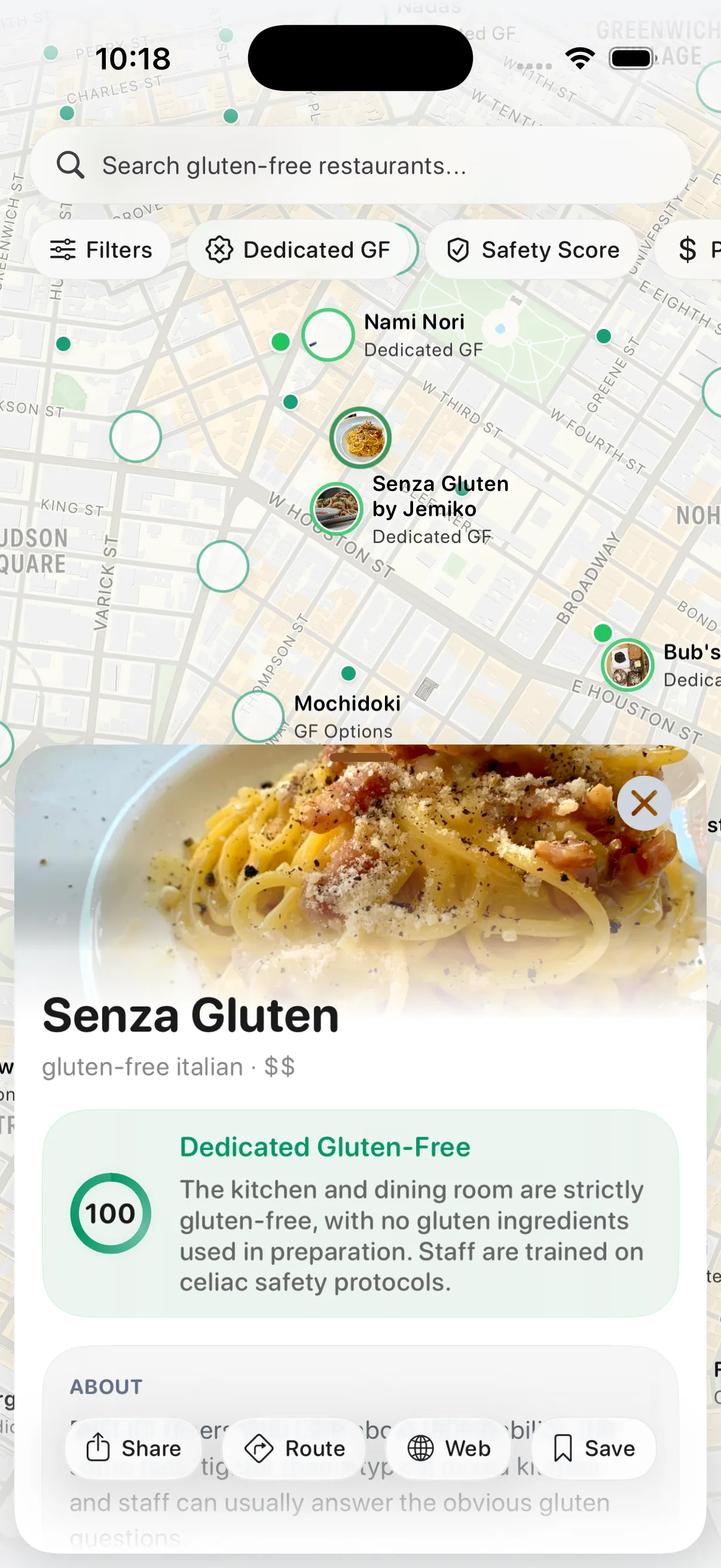
That thinking is what Sansglu's safety scores formalize. The methodology is public.
The craft part
I've been building software my whole life. The first app I ever shipped to the App Store was a calculator. Since then I've worked as an engineer at startups, big companies, and in healthcare, on products that serve millions of people.
I'd describe myself as a product engineer who works with empathy for the user, down to where every pixel sits. With Sansglu the design obsession is not decoration. When you can feel the care behind an interface, you can start to believe in the care behind the safety data. For an app a celiac is trusting with their health, that connection is the whole product.
Where you'll find me eating
I personally visit the restaurants in our guides. I eat there, ask the kitchens my questions, and add new places as I travel. Two that got to me: Sgrano in Florence, a gluten-free focacceria I went back to three times in one trip, and Bub's Bakery in New York, whose baked goods I still think about. After years of watching other people eat the good stuff, a sandwich that's simply excellent, no asterisk, is a genuinely emotional experience.
Where this is going
The goal will take years: every city a celiac might land in, mapped with the same honesty. New York came first because I could verify it in person. More cities are coming the same way.
Guides by Guri
About Guri
Guri is the founder of Sansglu, a gluten-free restaurant guide built for people with celiac disease. Diagnosed at eleven, he has managed the disease ever since. He is a product engineer who has shipped apps used by millions, and he personally visits and vets the restaurants in Sansglu's guides.