How our safety scores work
Celiac disease affects roughly 1 in 100 people worldwide, and as little as 10 milligrams of gluten a day can trigger immune responses that damage the small intestine. A "gluten-free" label on a menu does not make a dish celiac-safe: shared fryers, cutting boards, cookware, and airborne flour can contaminate otherwise safe ingredients. That gap between the label and the kitchen is what our scores measure.
Every score traces back to specific evidence about how a kitchen actually runs, never to a guess. When a safety feature is only suggested by reviews or secondary signals, we label it "reported," not "verified," until the restaurant itself or an established celiac community source confirms it.
Database scope
Data sources, in order of authority
Safety scores combine multiple sources, each weighted by its reliability and how close it sits to ground truth:
1. Restaurant-sourced data (highest authority)
Information directly from the restaurant: official websites, published menus, stated allergen policies, and kitchen configuration such as a dedicated gluten-free kitchen or separate preparation areas. When a restaurant explicitly states its cross-contamination protocols, that carries the highest weight in our scoring.
2. Celiac community databases
Curated listings from established celiac community platforms with their own verification processes. Restaurants listed there have typically been vetted by people who personally manage celiac disease and understand the stakes of cross-contamination.
3. Google Maps and review data
Public reviews mentioning "celiac," "gluten-free," or "cross-contamination" are analyzed for sentiment and specific claims. We look for patterns across many reviews rather than relying on any single one. Google Maps also provides business attributes, hours, and location data.
4. How we read the evidence
We read each restaurant's menu, allergen statements, and the patterns across its reviews, then cross-reference them against how the kitchen is set up: dedicated versus shared prep, separate fryers, and how staff talk about cross-contact. Repeated, consistent signals weigh far more than any single mention, and anything we cannot confirm stays labeled "reported."
5. Community reports
Sansglu users submit safety reports and corrections through the app. These first-party reports from people who have eaten at the restaurant provide real-world validation for the other sources.
Safety score tiers
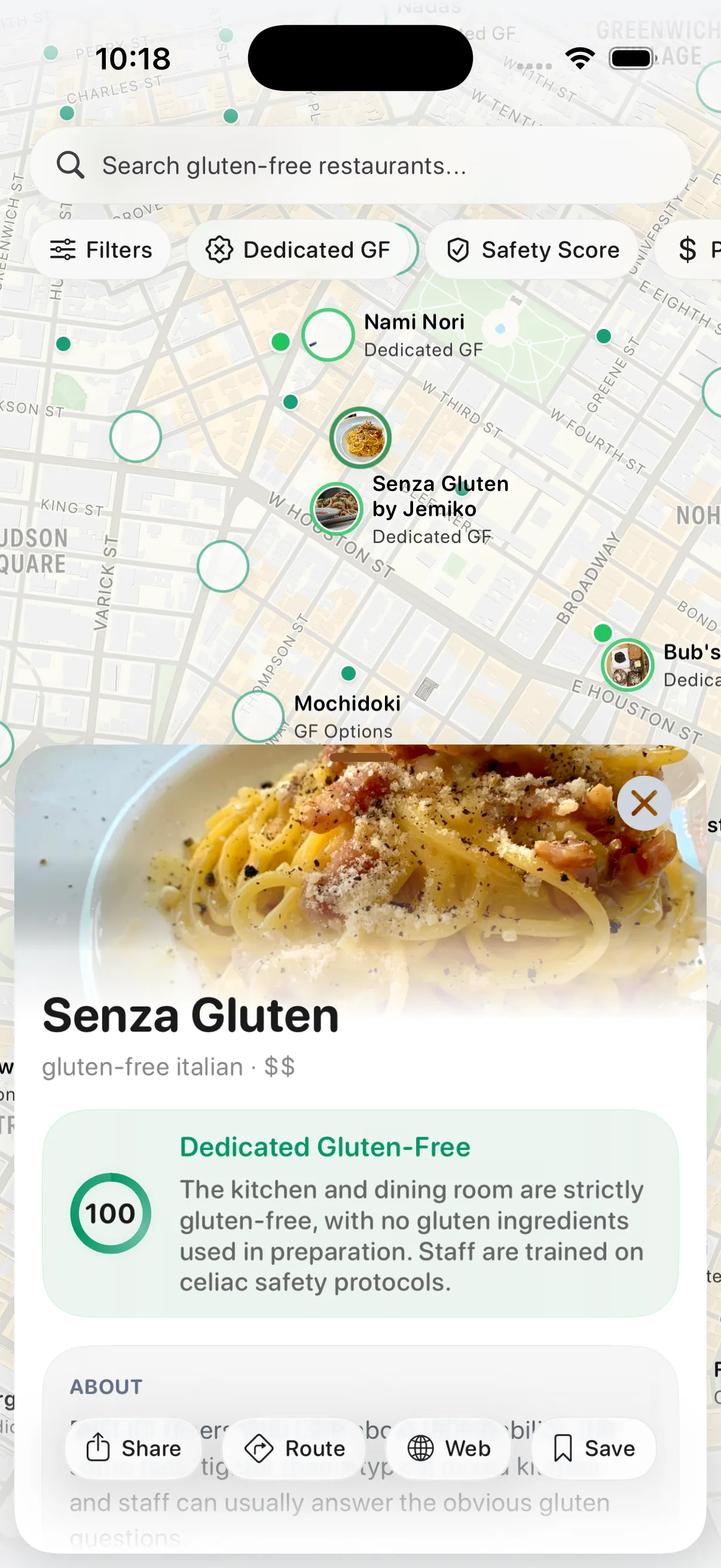
Sansglu publishes a celiac safety score from 0 to 100 when the available evidence supports one. The score summarizes documented gluten-free dining signals; it is decision support, not a guarantee that a restaurant is safe for someone with celiac disease.
80–100: High confidence
Strong evidence of celiac safety from multiple sources. These restaurants typically have dedicated gluten-free preparation areas, are listed in celiac community databases, or are entirely gluten-free. Cross-contamination protocols are documented or confirmed.
40–79: Moderate confidence
Some safety information is available, but the evidence is incomplete. The restaurant may have gluten-free menu items and positive reviews from celiac diners, but lacks confirmed cross-contamination protocols. Ask staff about preparation procedures.
0–39: Insufficient data
Available safety evidence is limited or conflicting. When the evidence is too incomplete to substantiate a number, Sansglu withholds the score and shows the sourced facts and caveats instead.
Glace at Rockefeller Center is one example: its official menu confirms a gluten-free waffle cone and community reports describe broader gluten-free status, but current first-party sources do not confirm a dedicated facility or cross-contact procedures. Sansglu therefore shows that evidence without publishing a numeric score.
What factors affect the score
The score evaluates factors grounded in recommendations from celiac disease organizations:
- Dedicated GF kitchen or preparation area — the strongest indicator. Separate kitchens or designated GF prep zones eliminate the primary vector of cross-contamination.
- Cross-contamination protocols — documented practices such as separate fryers, dedicated cookware, ingredient segregation, and cleaning procedures between GF and regular preparation.
- Staff training and awareness — evidence that staff understand celiac disease versus gluten preference, can explain preparation procedures, and take allergen requests seriously.
- Celiac community recognition — listing in established celiac community databases, or positive reviews from celiac diners reporting safe experiences.
- Menu transparency — clear allergen labeling, distinct GF menu sections, and willingness to modify dishes for safety rather than just removing obvious gluten sources.
Dedicated gluten-free restaurants
A "Dedicated GF" label requires a restaurant statement, an established celiac source, or consistent evidence describing a fully gluten-free menu or facility. Each listing keeps that source visible and records known shared-space or other-allergen caveats. Ingredients and practices can change, so the label is a strong signal rather than a guarantee.
Data freshness
- Nightly publication runs — new restaurants are reviewed against our safety standards, scored, and published each night.
- Hourly page revalidation — published restaurant pages refresh at least every hour to reflect the latest data.
- Community-triggered updates — safety reports from users prompt immediate re-evaluation of affected scores.
- Search engine notification — newly published and updated pages are submitted to Google and Bing so the latest data shows up in search quickly.
Related Sansglu pages
If you are evaluating the product behind this methodology, these are the best companion pages to read next:
Limitations, plainly
Transparency about our limits matters as much as confidence in our strengths:
- Restaurant practices can change at any time. A safe restaurant today may change chefs, suppliers, or protocols tomorrow.
- Our data reflects publicly available information and community reports, not firsthand kitchen inspections.
- Coverage varies by region. Major metropolitan areas typically have more data points than rural locations.
- Reading menus and reviews surfaces strong signals, but it cannot physically inspect a kitchen. Anything we have not confirmed firsthand is labeled "reported," not "verified."
Medical context
Our methodology is informed by established celiac organizations:
- The American College of Gastroenterology (ACG) clinical guidelines recommend a strict gluten-free diet as the primary treatment for celiac disease, emphasizing that even small amounts of gluten can cause intestinal damage.
- The U.S. FDA defines "gluten-free" as containing less than 20 parts per million (ppm) of gluten, the internationally recognized threshold for celiac safety.
- The Celiac Disease Foundation reports that approximately 1 in 100 people worldwide are affected by celiac disease, with most remaining undiagnosed.
- Beyond Celiac and other patient advocacy organizations identify dining out as one of the greatest challenges for people managing celiac disease.
Important disclaimer
Sansglu safety scores are informational tools designed to help you make more informed dining decisions. They are not medical advice and do not replace the guidance of your healthcare provider.
Always communicate your dietary needs directly with restaurant staff before ordering, and confirm current preparation practices, since procedures change. If you have celiac disease, ask specifically about cross-contamination protocols, not just whether a dish is "gluten-free."