The fastest reliable method is to start with restaurants that describe their whole kitchen as gluten-free, then verify that claim with current first-party information. When the kitchen is shared, check the exact dish, ingredients, prep surface, fryer, cookware, and staff answer before deciding. An app or review can help you build a shortlist. It cannot guarantee a meal.
This guide is for restaurant research and conversation planning. It is not medical advice, and "celiac-safe" is practical shorthand rather than a certification.
Reviewed August 2026 by Sansglu Editorial.
The short version
- Search for a fully dedicated gluten-free kitchen first.
- Read the restaurant's current menu and allergen information.
- Call during a quiet hour if the preparation details are unclear.
- Ask about the exact dish, shared fryers, prep space, utensils, and cooking water.
- Confirm the plan again when you order and keep a backup option.
The Celiac Disease Foundation recommends researching ahead, explaining that you have celiac disease, and asking specific cross-contact questions. Its current cross-contact handout also calls out dedicated fryers, clean cookware, separate pasta water, and advance contact.
Rank the evidence before you rank the restaurant
Not every gluten-free signal answers the same question.
| Signal | What it tells you | What it does not prove |
|---|---|---|
| The restaurant says its entire kitchen or facility is gluten-free | Wheat and other gluten sources should not be part of normal kitchen production | Current sourcing, non-gluten allergens, or whether the claim has changed |
| The restaurant publishes preparation and cross-contact procedures | Staff have a documented process for gluten-free orders | Every shift follows the process perfectly |
| A current menu marks a dish gluten-free | The recipe is intended to omit gluten ingredients | The fryer, grill, pasta water, utensils, or prep surface are separate |
| A recent celiac review describes the exact order and staff response | One diner had a specific, recent experience | The next shift, recipe, or supplier will be the same |
| A general star rating or "gluten-free friendly" label | People like the restaurant or it offers some options | Anything specific about celiac preparation |
Use stronger signals to narrow the list. Treat weaker signals as leads that still need questions.
1. Start with a dedicated gluten-free kitchen
A dedicated kitchen removes many shared-flour, shared-fryer, and shared-prep questions at once. It is usually the strongest starting signal for a person who needs strict gluten avoidance.
Search the restaurant's own website for phrases such as "100% gluten-free," "entirely gluten-free," or "dedicated gluten-free facility." Check the address and date because brands move, close locations, and change menus. A dedicated bakery in one city does not prove that another location uses the same setup.
Sansglu's editorial city guides use this stricter evidence gate for dedicated guides. The broader gluten-free city directory is useful for discovery, but every listing still needs its current kitchen details checked.
2. Read the current first-party menu
Open the restaurant's own menu or ordering page before relying on a search snippet. Look for the exact dish you want and scan every component: sauces, marinades, garnishes, breading, seasoning blends, imitation seafood, soy sauce, and desserts.
Then look for an allergen statement. A careful statement may say the kitchen is shared or that cross-contact cannot be prevented. That warning is useful information, not boilerplate to ignore.
If the restaurant only has an old PDF, a third-party menu, or a generic gluten-free icon, call. Do not fill the missing details with assumptions.
3. Ask questions that expose the kitchen path
"Is this gluten-free?" often produces a recipe answer. A person with celiac disease also needs the preparation answer.
Ask these questions about the dish you plan to order:
- Does any ingredient, sauce, marinade, or garnish contain wheat, barley, rye, or regular soy sauce?
- Is the food prepared on a cleaned or separate surface with clean utensils and cookware?
- Are fried items cooked in a dedicated fryer with separate oil?
- Is gluten-free pasta cooked in clean, separate water?
- Does the grill or flat-top also handle bread or flour, and can it be cleaned or separated?
- How will the order be marked so the kitchen knows it is for celiac disease?
Call outside the lunch or dinner rush when possible. The American Gastroenterological Association's patient guidance recommends checking menus before a trip and discussing the specific food and kitchen process with the restaurant.
4. Listen to the quality of the answer
A useful answer is specific: which fryer, which surface, which pasta water, and who marks the ticket. "We have gluten-free options" does not answer those questions.
Good signs include a staff member who:
- distinguishes ingredients from cross-contact;
- checks with the chef instead of guessing;
- names the separate equipment or cleaning process;
- explains what the kitchen cannot safely modify;
- is willing to say no.
Pause when the answers conflict, change between staff members, or promise zero risk without explaining the process. Choosing another restaurant is a valid outcome of the research.
5. Use restaurant apps as a shortlist, not a verdict
Restaurant apps solve different parts of the problem. Large community directories provide coverage and review volume. Curated tools can make kitchen signals easier to compare. Neither model can see the next shift or supplier change.
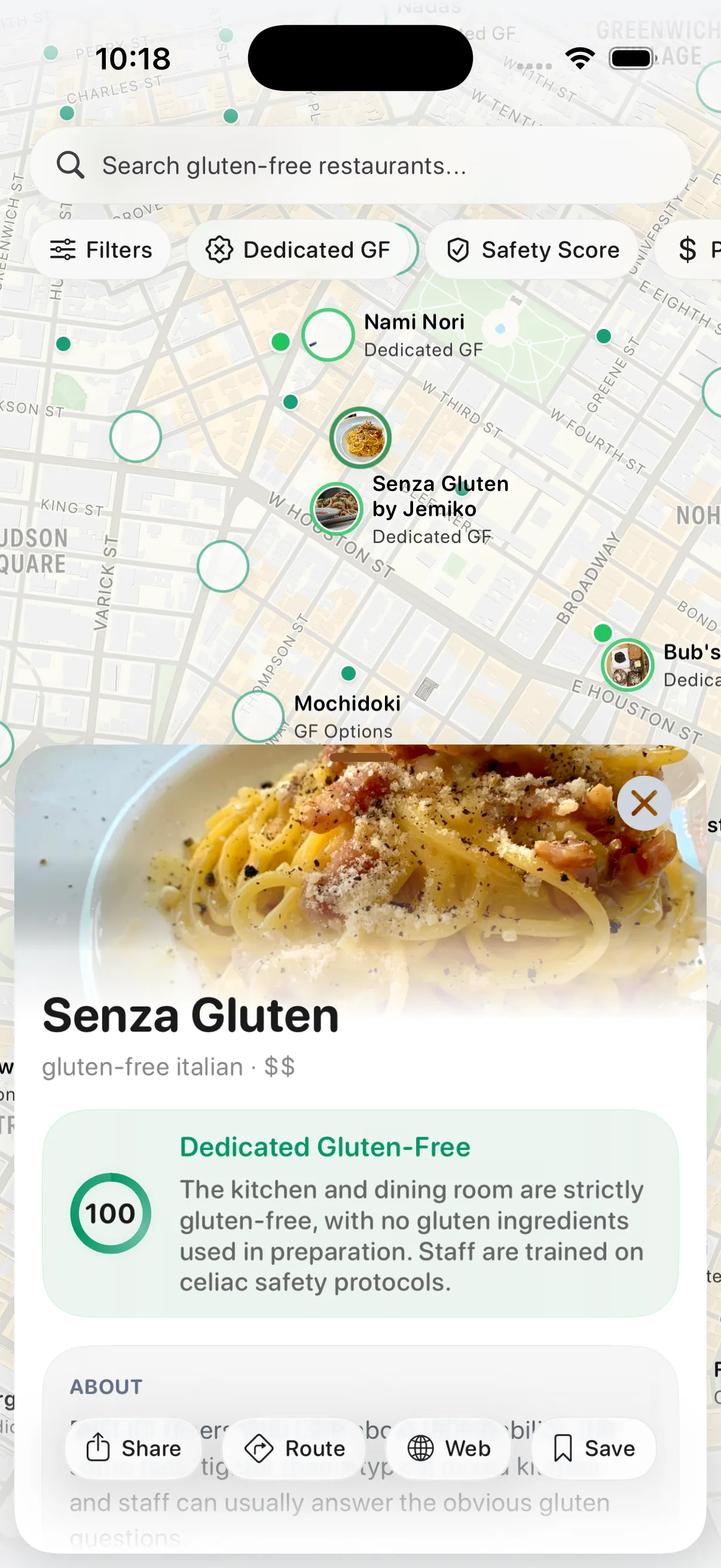
The Sansglu app shows dedicated-kitchen status, preparation signals, celiac reviews, and a 0 to 100 Safety Score when the evidence supports one. The Safety Score methodology explains what contributes to that number and where its limits are. If you compare multiple tools, our Find Me Gluten Free alternatives guide explains the trade-offs without pretending one app is best for every diner.
A practical workflow is:
- Use an app or city guide to create two or three candidates.
- Open each restaurant's current first-party menu.
- Check the strongest candidate's kitchen process.
- Save a second option in case the first answer changes.
6. Confirm again when you order
Even good advance research can go stale. Tell the server you have celiac disease, name the dish, and confirm the preparation plan. If the plate arrives with bread, a cookie, fried garnish, or another unexpected item, ask for a newly prepared dish rather than simply removing the item.
The National Celiac Association treats restaurant lists as starting points and reminds diners to assess their needs each time. That is the right mental model for any directory, review, score, or guide.
The travel version
Research before arrival, not when everyone is already hungry. Save dedicated kitchens near your hotel, airport, and main activities. Screenshot menus and addresses in case data service fails. Pack food for transit days and late arrivals.
For international travel, bring a translation card that describes celiac disease and cross-contact. A literal translation of "gluten-free" may not explain separate oil, soy sauce, flour in the kitchen, or clean cookware.
Use the same evidence order abroad: dedicated kitchen, current first-party menu, specific preparation answer, recent celiac experience, then general reviews.
Red flags that deserve a second option
- The menu says "gluten-sensitive" but publishes no preparation details.
- The only evidence is an old review or an undated search snippet.
- Staff say the fryer is safe but also say breaded food uses the same oil.
- The gluten-free pasta shares water with wheat pasta.
- A server promises the meal is safe but cannot describe how it is prepared.
- The restaurant's website and staff give different answers.
None of these automatically proves that every dish is unsuitable. They do mean the current evidence is not strong enough to carry confidence on its own.
Build a repeatable system
Save the questions in your phone. Keep notes on dishes and staff answers, but date them. Re-check after a long gap because menus, managers, suppliers, and equipment change.
The goal is not to find a magic label. It is to make the kitchen path visible enough for you to make your own decision, with a backup when the evidence stays unclear.
Read how Sansglu sources restaurant data, browse the celiac-focused app, or start with a current editorial city guide.